

Driver negligence causes most Utah motorcycle crashes, and failure to yield, particularly a car turning left across a rider's path, sits at the top of the list. Lane changes into blind spots, following too closely, impaired and distracted driving, speed, and road hazards make up most of the rest. Each one carries different consequences for how fault gets assigned.
Motorcycle crashes are not car crashes with fewer wheels. A rider has no airbag, no seatbelt, and no steel structure absorbing the impact, so a collision that would be a fender bender in a car can be catastrophic on a bike. Understanding what actually causes these crashes matters both for avoiding them and for proving what happened afterward.
Riders face greater risk because motorcycles have none of the protective structure a car does. Traumatic brain injuries, spinal cord injuries, and fractures are among the most common results, and they can come from collisions that would barely mark a passenger vehicle.
Utah’s geography adds its own hazards. Canyon roads with sharp curves, mountain passes with sudden elevation changes, and dense urban corridors each produce a different risk profile, and riders here move between all three regularly.
In multi-vehicle crashes, the other driver’s error is identified more often than the rider’s. Utah Highway Safety Office data for 2020 through 2024 shows 56 percent of motorcycle crashes involve another motor vehicle, frequently where that driver failed to yield or turned improperly. Single-vehicle crashes look different, usually involving speed, loss of control, or a road hazard rather than another car.
The left-turn crash is the one riders fear most, and with reason. A driver waiting to turn left across oncoming traffic misjudges the speed or distance of an approaching motorcycle, or does not see it at all, and begins the turn. The rider has almost no time to brake or swerve.
A motorcycle’s narrow profile disappears into traffic, particularly against a background of cars and visual clutter at a busy intersection. Drivers scan for larger vehicles and filter out smaller ones without realizing they are doing it.
Under Utah law the turning driver almost always bears fault, because the driver making the turn has a duty to yield to oncoming traffic. Failure to yield is a primary traffic violation, and where that violation causes a crash, liability sits heavily on the turning driver. The Utah Highway Safety Office identifies failure to yield as a leading contributing factor in motorcycle fatalities.
Proving fault in one of these usually takes:
A motorcycle fits entirely inside the area a standard mirror cannot capture. When a driver changes lanes without a proper head check, a rider occupying that space has nowhere to go.
These crashes cluster on multi-lane highways and urban arterials where speeds are higher and lane changes are constant. The driver signals briefly, or not at all, and moves over, either striking the motorcycle or forcing evasive action. Even a glancing contact can put a rider down.
Utah Highway Safety Office data lists failure to keep in the proper lane and unsafe lane changes among the primary contributing factors in serious and fatal crashes from 2020 through 2024. Distraction compounds it, because a distracted driver is even less likely to check a blind spot properly.
Riders can reduce exposure through positioning: riding in the part of the lane where you sit in other drivers’ mirrors, wearing high-visibility gear, using high beams at night, and not lingering alongside other vehicles. None of it eliminates the risk from a driver who simply does not look.
Liability normally falls on the lane-changing driver, who has a duty to make sure the lane is clear. The analysis mirrors a left-turn crash: whether the driver exercised reasonable care, with damage patterns, witness accounts, and vehicle positions usually settling it.
A motorcycle’s stopping distance shifts with speed, road surface, tire condition, and braking technique. When a car or truck is tailgating a rider, there is no margin left for any of that.
Rear-end collisions are especially dangerous on a bike. An impact that produces minor whiplash in a car can throw a rider off the motorcycle entirely, and head trauma is a leading cause of death and serious injury in motorcycle crashes.
Tailgating is illegal in Utah, and state driver licensing guidance recommends keeping at least a two-second following distance, more in poor weather or on bad road surfaces. The Utah Highway Safety Office lists following too closely as a recurring contributing factor in motorcycle crashes.
Fault in a rear-end crash is usually straightforward. The following driver has a duty to keep a distance that allows adequate reaction and stopping time, and a rear-end impact creates a strong presumption of negligence against that driver.
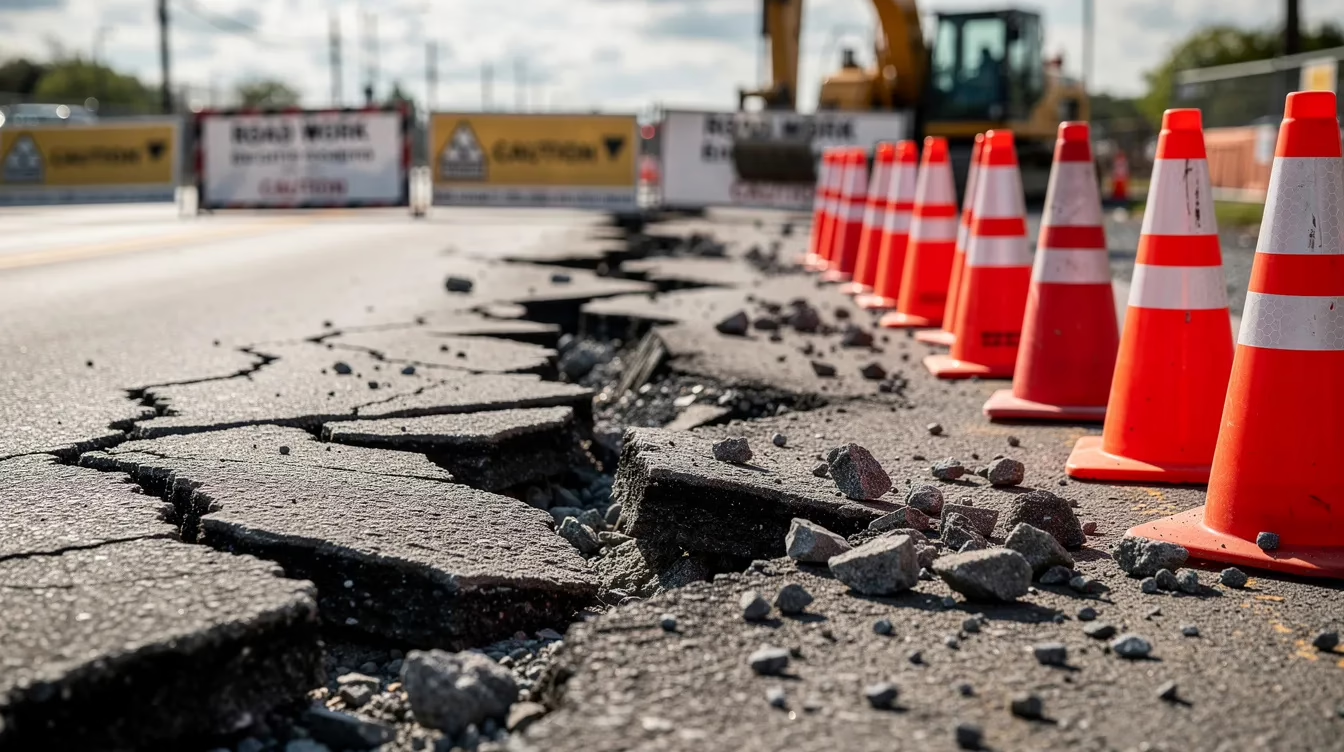
A pothole a car absorbs as a bump can put a motorcycle down. Gravel, sand, debris, uneven pavement, construction plates, oil, and wet surfaces all affect two wheels far more severely than four. Mechanical problems such as brake failure or a tire blowout can cause a crash with no other vehicle involved at all.
Utah’s freeze-thaw cycles open potholes and pavement cracks every spring, which is exactly when riders come back to the road after winter. Construction zones add steel plates, uneven lane transitions, and loose aggregate, all of which are worse on a bike. Sudden summer storms can turn dry pavement slick within minutes.
Even so, Utah Highway Safety Office data shows 86 percent of motorcycle crashes happen between April and October, in mostly good weather. That points at rider and driver behavior rather than conditions as the main driver of crash frequency.
Where a crash results from a dangerous highway condition or a roadway defect, the responsible government entity, whether that is UDOT, a county, or a city, may bear liability under Utah’s Governmental Immunity Act.
These claims carry a much shorter clock than an ordinary injury claim. A written notice of claim is required within one year after the claim arises, describing the circumstances, the damages, and any government employees involved. Missing that notice deadline can bar the claim permanently, no matter how strong the underlying case is. If you think a road defect caused your crash, filing a motorcycle claim against the government entity requires careful documentation- photographs, location data, and maintenance records, needs to start immediately.
Alcohol and drugs impair judgment, motor skills, and reaction time, and they do it to both riders and drivers. Utah Highway Safety Office data for 2020 through 2024 shows 21 percent of motorcycle fatalities involved impaired driver behavior.
Utah’s blood alcohol limit of 0.05 percent is the lowest in the nation, which reflects how the state has chosen to approach impaired driving.
Distraction is the other half of this. A driver looking at a phone for a few seconds covers the length of a football field without registering what is around them, and because motorcycles are harder to see in the first place, a distracted driver is far less likely to notice a bike than a larger vehicle.
Liability in these cases tends to be clear. A driving under the influence arrest or citation is strong evidence of negligence, and distraction can be established through phone records, witness testimony, and the dynamics of the crash itself.
Speed cuts reaction time and raises crash severity, and it applies to riders and drivers alike. Utah Highway Safety Office data for 2020 through 2024 shows 33 percent of motorcycle fatalities and 32 percent of serious injury crashes involved speeding.
The physics are unforgiving. Energy transferred in a collision rises with the square of speed, so a crash at 60 miles per hour involves roughly four times the energy of one at 30.
Rider training belongs in this conversation without turning into victim-blaming. Utah’s 2025 data revealed a troubling pattern: more than 75% of riders who died had no motorcycle endorsement, and fewer than 10% had ever taken a safety course. Formal training builds crash-avoidance skill and hazard recognition, and riders without it are less prepared for the split-second decisions motorcycling demands.
Lane splitting is prohibited in Utah, and riding between vehicles in moving traffic puts a rider where drivers are not expecting one. Lane filtering between stopped vehicles remains legal under specific conditions, which our lane splitting page covers in detail.
Under Utah’s comparative fault system, a rider’s own speed or inexperience can reduce a recovery where those factors contributed to the crash. It does not erase a negligent driver’s responsibility, it adjusts the proportions. A rider slightly over the limit who is struck by a driver running a red light still has a strong claim, with recovery reduced by whatever share of fault is assigned to the rider.
The Utah Highway Safety Office recorded 5,887 motorcycle crashes between 2020 and 2024, resulting in 229 motorcycle fatalities. That averages to roughly 1,177 crashes a year across the five-year period.
Patterns from that same data set:
Riding without a helmet does not cause a crash. It changes how likely that crash is to be fatal.
Each of these causes carries different implications for fault, for what evidence matters, and for what you can recover. If you have been injured, these steps protect your position:
If a government entity may be responsible for a roadway defect, the one-year notice deadline makes speed essential. Talking to a lawyer who works with Utah’s comparative fault system and understands motorcycle crash dynamics can help you understand where your claim stands.
Driver negligence, and specifically other drivers failing to yield the right of way. In Utah, failure to yield and improper turns rank as the top contributing factors in multi-vehicle motorcycle crashes, with the left-turn collision being the most common form.
In most cases the driver making the left turn, because that driver has a duty to yield to oncoming traffic including motorcycles. Utah’s comparative fault rule means a rider’s recovery can be reduced if the rider was speeding or otherwise contributed, but the turning driver typically bears primary liability.
Government entities can be liable for injuries caused by a dangerous highway or road condition under Utah’s Governmental Immunity Act. A written notice of claim is required within one year of the crash, and that deadline is strictly enforced, so preserving evidence and acting quickly matters a great deal here.
Utah Highway Safety Office data shows urban counties, Salt Lake, Utah, Davis, Weber, and Washington, account for the large majority of motorcycle fatalities. High-traffic corridors, multi-lane highways, and intersections in those areas carry the greatest risk because of traffic volume and frequent lane changes. Canyon roads with sharp curves present a different but real hazard.
The Utah Highway Safety Office recorded 5,887 motorcycle crashes between 2020 and 2024, which averages roughly 1,177 a year, producing 229 fatalities over that period. To help avoid motorcycle accidents, riders should pursue formal training, wear proper gear, and ride defensively.
This is general information, not legal advice. Contacting Robert J. DeBry & Associates or submitting a form does not create an attorney-client relationship.