

Yes, a pedestrian can be partially or fully at fault for a car accident in Utah. Pedestrians can be at fault for jaywalking or unsafe crossings, ignoring traffic signals, or stepping suddenly into traffic. But partial fault does not automatically end a pedestrian’s right to seek compensation. Under Utah’s modified comparative negligence system, an injured pedestrian can still recover damages as long as their share of fault stays below 50 percent.
Both the driver and the pedestrian carry legal duties under Utah traffic laws. When a pedestrian accident occurs, the question is not simply “who broke a rule” but rather how much each party’s actions contributed to the collision. That fault determination, expressed as a percentage, directly controls how much compensation the injured pedestrian can receive.
Understanding how fault works in pedestrian car accident cases matters because the difference between 49 percent fault and 50 percent fault is the difference between reduced compensation and no compensation at all. If you were involved in a traffic accident as a pedestrian, here is what you need to know:
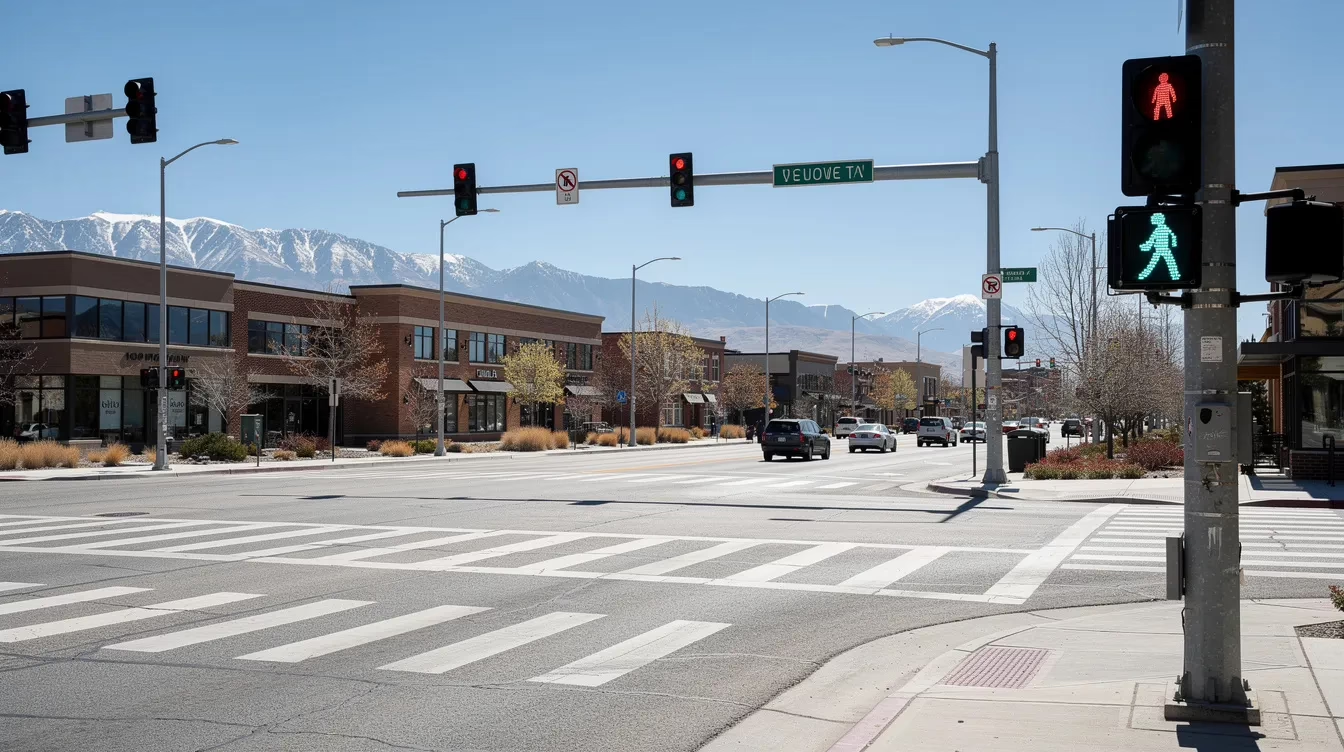

Utah follows a modified comparative negligence system under Utah Code section 78B-5-818. Comparative negligence means fault can be split by percentages between parties. Under this rule, an injured person can recover damages only when the combined fault of all defendants exceeds that person’s own fault. If the injured pedestrian’s fault reaches 50 percent or more, recovery is completely barred.
This threshold matters enormously. At exactly 50 percent pedestrian fault, the defendant’s share does not exceed the pedestrian’s share, so the pedestrian recovers nothing. Courts may find shared fault in pedestrian accidents based on comparative negligence laws, but the 50 percent line is where the claim lives or dies.
Other states handle this differently. Virginia’s contributory negligence rule bars recovery if a pedestrian is even 1 percent at fault. Under contributory negligence, Virginia pedestrians cannot recover if at fault at all. Utah’s modified comparative negligence allows recovery if the pedestrian is under 50 percent at fault, placing it between these two extremes.
Fault is assigned as percentages that total 100 percent across all responsible parties. When a pedestrian shares fault, their compensation is reduced by their exact percentage of responsibility.
If a pedestrian is found 30 percent at fault for crossing outside a designated crosswalk and the vehicle driver is 70 percent at fault for speeding, the pedestrian can recover 70 percent of their total damages. At 49 percent pedestrian fault, recovery is still possible, though reduced to 51 percent of total damages. But at 50 percent fault or higher, the injured pedestrian recovers nothing.
In complex accidents, multiple parties can share fault. For example, both the pedestrian and a reckless driver might share responsibility alongside a municipality that failed to maintain adequate crosswalk signage. The percentages across all parties still must total 100 percent, and the pedestrian’s share is measured against the combined fault of all defendants.
Insurance companies have a direct financial incentive to push a pedestrian’s fault percentage as high as possible, ideally to 50 percent or above, where the claim disappears entirely. Understanding these tactics is essential when seeking compensation after a pedestrian car accident.
Common arguments insurers raise include:
These arguments are not always wrong, but they are often exaggerated. An insurer might characterize a pedestrian crossing five feet outside a faded crosswalk as reckless jaywalking, or claim that wearing a dark jacket at dusk makes the pedestrian primarily responsible for an accident that occurred because the driver fails to use headlights. Strong legal representation helps counter inflated fault arguments with actual evidence about the specific circumstances of how the accident occurred.
Jaywalking is a common scenario for pedestrian fault, and it is the argument insurance companies reach for first. Jaywalking involves crossing mid-block or outside a designated crosswalk. Under Utah Code section 41-6a-1003, a pedestrian who crosses a roadway outside a marked or unmarked crosswalk must yield the right of way to vehicles. Violating that duty can increase a pedestrian’s fault percentage.
But crossing outside designated areas does not automatically assign full fault or even majority fault. The driver’s duty of due care toward pedestrians does not vanish because the pedestrian was mid-block. Utah Code section 41-6a-1006 requires drivers to exercise reasonable care to avoid hitting pedestrians at all times, to give audible signals when necessary, and to use extra caution when a pedestrian appears to be a child, confused, or incapacitated.
Whether jaywalking pushes fault to a significant percentage depends on the full picture: visibility at the location, whether the driver was maintaining proper speed limits, traffic conditions, whether the pedestrian was visible to an attentive driver, and how far the pedestrian was from the nearest crosswalk. A pedestrian who crosses a quiet residential street 20 feet from a crosswalk on a clear afternoon is in a very different legal position than one who darts across a six-lane highway in the dark.
Jaywalking can shift fault to the pedestrian in accidents, but the shift depends on these surrounding facts, not on the crossing location alone.
Regardless of what the pedestrian did, certain driver behaviors carry heavy weight in determining fault. Both the driver and the pedestrian owe duties of care, and when the driver violates those duties, fault shifts significantly.
Speed and traffic violations. A driver exceeding posted speed limits has less time to react and causes greater injury on impact. Running a red light or stop sign when a pedestrian has the right of way is a serious violation. Under Utah Code section 41-6a-1002, drivers must yield to pedestrians in marked and unmarked crosswalks. Improper turning without checking for pedestrians, particularly right turns on red, is another frequent cause of car accidents involving pedestrians.
Distraction and impairment. Distracted driving, including texting, phone calls, or adjusting navigation, is one of the strongest fault factors against a driver. A driver impaired by alcohol or drugs faces substantial legal responsibility. Fatigue that reduces reaction time functions similarly. When a vehicle driver is distracted or impaired, proving liability against them becomes more straightforward.
Environmental factors and vehicle issues. Drivers have a duty to adjust their driving for conditions. Failure to use headlights in low-light conditions, driving too fast for rain or fog, or backing up without proper observation all increase driver fault. Vehicle maintenance issues affecting braking or visibility, such as burned-out headlights or worn brake pads, can also establish fault against the driver.
According to Utah’s Strategic Highway Safety Plan, pedestrian fatalities accounted for nearly 18 percent of all traffic-related deaths in Utah in 2024, underscoring the severity of these collisions and the importance of driver vigilance.
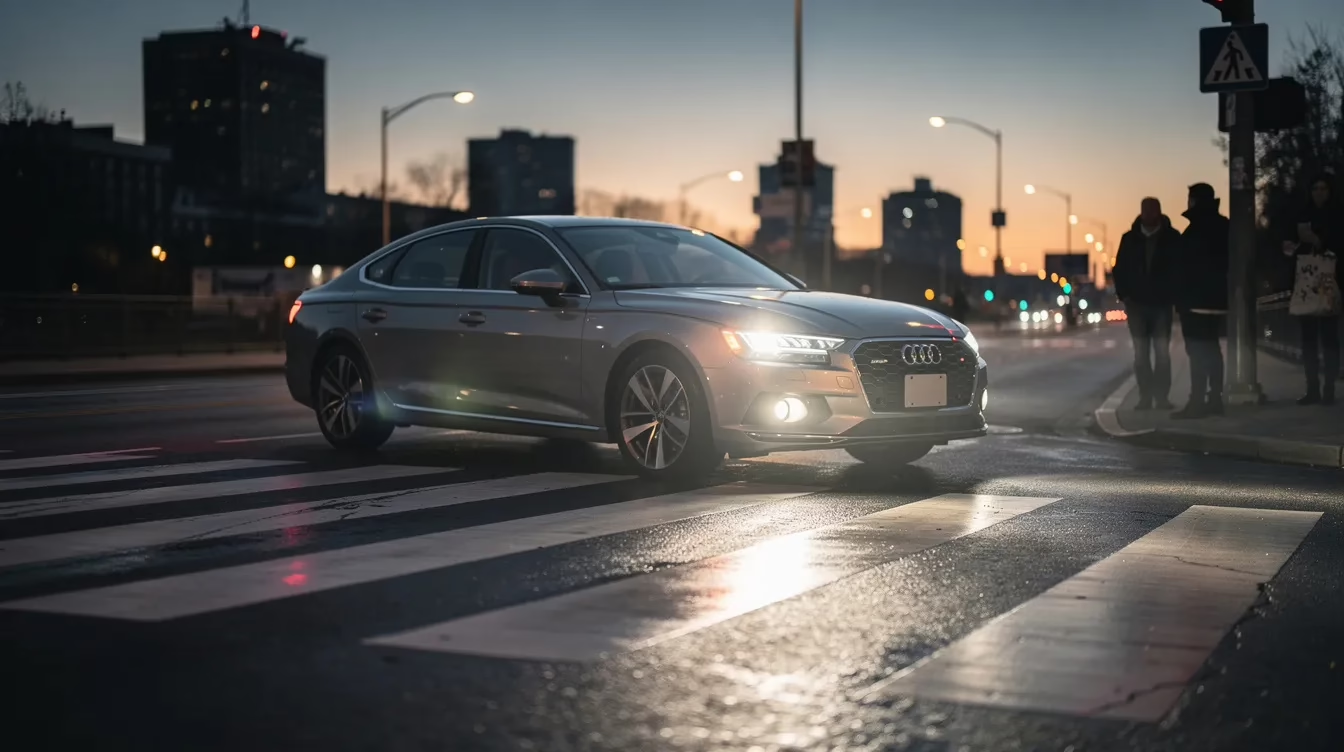
Certain pedestrian behaviors increase fault percentage, sometimes significantly. Common pedestrian faults include jaywalking and ignoring traffic signals.
Stepping suddenly into traffic. Under Utah Code section 41-6a-1002, a pedestrian may not suddenly leave a curb or other safe place and walk or run into the path of an oncoming vehicle when the vehicle is so close as to constitute an immediate hazard. Sudden “dart-outs” happen when pedestrians step abruptly into traffic, and this violation can create substantial pedestrian fault because even an attentive driver cannot react in time.
Ignoring traffic signals. Ignoring signals includes walking against a red light or “Don’t Walk” signal. Pedestrians must obey traffic signals like drivers do. Under Utah Code section 41-6a-1001, pedestrians fail to follow traffic laws when they cross against pedestrian-control signals. Ignoring traffic signals can shift fault to the pedestrian considerably.
Distracted walking. Distracted walking can occur while using a smartphone or wearing headphones. A pedestrian who is looking at a phone rather than watching for approaching vehicles may not notice traffic conditions that would otherwise be obvious. Distracted walking can lead to pedestrian liability in accidents, though it rarely results in full liability on its own. Distracted walking increases pedestrian liability in accidents when combined with other factors like crossing outside a crosswalk.
Impairment. Being under the influence of drugs or alcohol impairs pedestrian judgment and reaction. Pedestrians under the influence may be found at fault and may share fault in accidents because impairment affects their ability to follow traffic rules, perceive danger, and react appropriately. However, impairment alone does not automatically push fault to 50 percent. The driver’s own behavior still matters. If the driver was also negligent, the at fault pedestrian may still have a viable claim.
Walking in the roadway. Utah Code section 41-6a-1009 requires pedestrians to use sidewalks when available. Walking on the roadway where a sidewalk exists can contribute to fault. Walking in prohibited zones involves entering highways or tunnels where pedestrians are forbidden, which carries even greater fault implications.
Visibility choices. Visibility is affected when pedestrians wear dark clothing at night or during poor weather. While no Utah statute specifically requires reflective clothing, failing to be reasonably visible can contribute to a finding that the pedestrian did not exercise reasonable care.
Determining fault in a pedestrian accident is a factual investigation, not a snap judgment. Investigators consider visibility, location, and traffic laws when determining fault. Police reports provide an initial assessment, but they are not the final word. The responsible party’s actual percentage of fault is determined through all available evidence, often decided by an insurer, judge, or jury.
Thorough investigation of the accident scene often includes site inspection for visibility obstructions and traffic control devices, documentation of weather and lighting conditions at the time of the collision, and expert analysis of what constituted reasonable pedestrian and driver behavior given those conditions. Medical evidence linking serious injuries to specific impact patterns can also help establish fault by showing the direction and force of the collision.
This is why gathering evidence promptly matters. Physical evidence changes, video gets overwritten, and witness testimony fades. Experienced personal injury attorneys can preserve critical evidence before it disappears.

When a pedestrian shares fault, the financial impact follows a direct mathematical relationship. Every percentage point of fault reduces the injured pedestrian’s recovery by that same percentage, applied across all categories of damages: medical bills, lost wages, pain and suffering, and future treatment costs.
In some cases, personal injury protection may cover initial injury-related costs regardless of fault, subject to policy limits and coverage rules.
Consider what this means practically. If a pedestrian’s total damages are substantial and they are found 20 percent at fault, they lose 20 percent of every dollar. If fault rises to 40 percent, they lose 40 percent. At 50 percent, they lose everything.
This arithmetic makes the fault percentage one of the most consequential numbers in any pedestrian accident case. Even small shifts in fault assignment can significantly impact recovery when medical bills and lost wages are substantial. The difference between a 25 percent fault finding and a 35 percent fault finding can represent a meaningful amount of money.
This is why minimizing the fault percentage, rather than simply proving the driver was negligent, is often the central task in pedestrian car accident cases. The driver’s insurer will push the number up. The pedestrian’s legal team works to push it down, using evidence that the driver’s negligence, not the pedestrian’s actions, was the primary cause.
If you are involved in a car pedestrian accident, the steps you take immediately afterward can affect both your health and your ability to recover damages:
Yes. Pedestrians can be partially or fully at fault for a car accident. Common fault factors include jaywalking, ignoring traffic signals, stepping suddenly into traffic, distracted walking, and impairment. However, partial fault does not automatically bar recovery. Under Utah’s modified comparative negligence system, an injured pedestrian can still recover damages if their fault is below 50 percent.
If a pedestrian’s negligence caused or contributed to the accident, they may be held liable for a portion of the damages, including vehicle damage and injuries to the driver. The pedestrian’s own compensation for injuries would be reduced by their fault percentage, or eliminated entirely if their fault reaches 50 percent or more under Utah Code section 78B-5-818.
No. Crossing outside a designated crosswalk increases your duty to yield and may increase your fault percentage, but it does not automatically place you at or above 50 percent fault. The driver’s own conduct, including whether they exercised reasonable care and followed traffic rules, still factors into how fault is determined. Many pedestrians who were outside crosswalks retain viable claims.
Under Utah Code section 78B-5-818, an injured person can recover damages only if the combined fault of all defendants exceeds the injured person’s own fault. If the pedestrian’s fault reaches exactly 50 percent, the defendants’ fault does not exceed the pedestrian’s fault, and recovery is barred. This makes the 50 percent threshold the critical line in any Utah personal injury case.
No. Police reports document initial observations, statements, and sometimes citations, but they do not assign final fault percentages. Fault is ultimately determined through the full body of evidence, including video footage, signal timing data, witness statements, accident reconstruction, and medical records. The final determination is made by the insurer, a judge, or a jury.
Yes, as long as your fault stays below 50 percent. Your compensation is reduced in direct proportion to your fault percentage. For example, at 20 percent fault, you can recover 80 percent of your total damages. An experienced pedestrian accident lawyer can help gather evidence to minimize your assigned fault percentage and protect your right to recover damages.
Fault determination in a pedestrian accident involves detailed evidence analysis, knowledge of Utah’s comparative negligence system, and the ability to counter insurance company arguments designed to push your fault percentage toward the 50 percent bar. The specific circumstances of each case, from where the pedestrian crosses the road to whether the driver was maintaining proper speed, shape the outcome.
Robert J. DeBry & Associates has been representing injured parties in Utah personal injury law since 1981. The law firm handles pedestrian accident cases throughout Utah, working to gather evidence, determine liability, and pursue fair compensation for clients who have been injured.
If you were hurt in a pedestrian accident and have questions about fault, contact Robert J. DeBry & Associates for a free consultation. The firm works on a contingency fee basis, meaning you pay nothing unless there is a recovery. Offices are located in Salt Lake City and Sandy.
This is general information, not legal advice.