

If you have been hit by a drunk driver in Utah, your first priorities are safety, medical care, and preserving evidence. Act quickly after a DUI accident to protect your rights. Call 911 so police and emergency medical services respond to the scene. Document everything you can. Then consult a Utah personal injury attorney within days of the crash to prevent insurance manipulation and ensure no deadline is missed.
Drunk driving accidents often cause serious injuries or death, and victims face a complicated path through criminal proceedings, insurance claims, and potential civil lawsuits. This page walks through the critical steps at the scene, explains how the criminal DUI case relates to your civil claim, identifies every source of compensation that may be available, and covers what suing a drunk driver in Utah actually looks like.
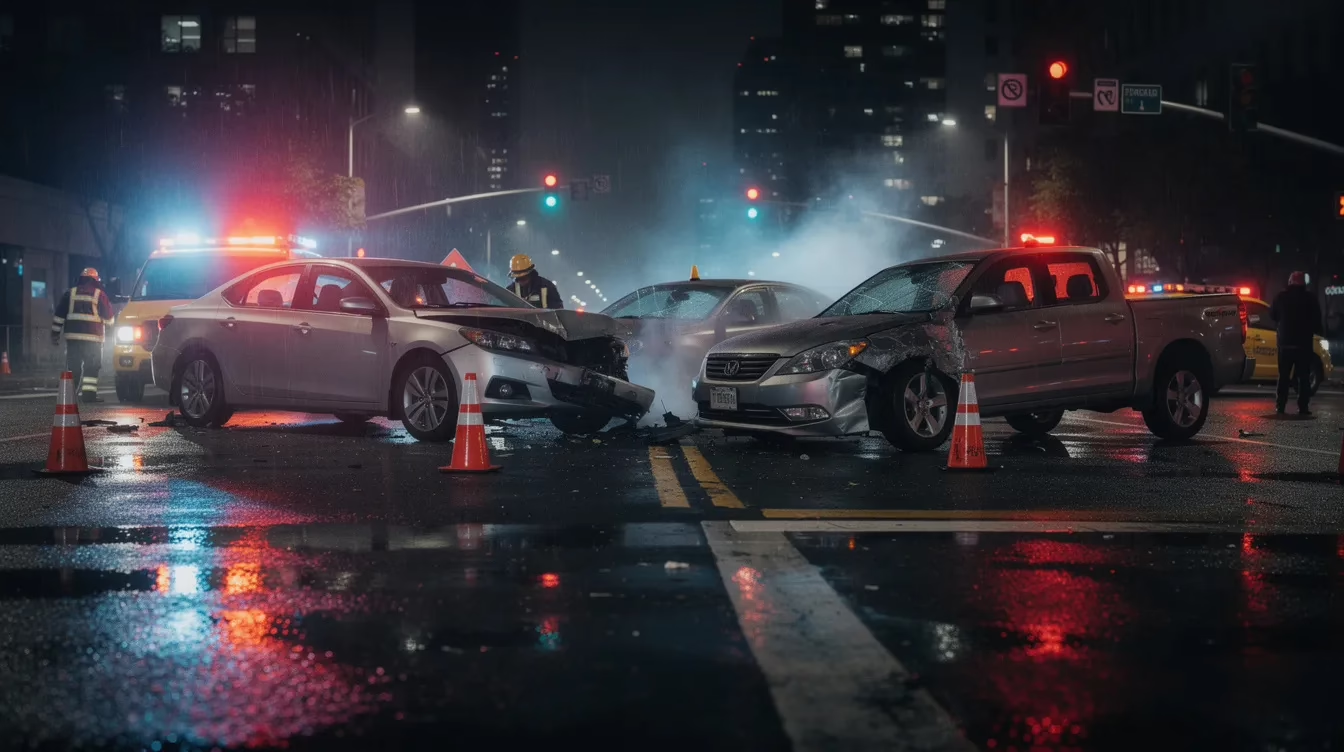
The moments after a suspected DUI crash are chaotic, but what you do at the scene can determine the strength of your entire claim. Police reports provide essential evidence of driver impairment, so getting officers to the scene quickly is essential.
Call 911 before anything else. This accomplishes three things at once: it brings police to investigate and document the crash, dispatches emergency medical services for anyone who is injured, and creates an official record that a collision happened. If the other driver appears impaired, say so when you call. Officers will conduct field sobriety tests and may administer chemical tests to determine whether the driver was impaired by alcohol or drug use.
Remain at the scene until police arrive. Police may also note who was in the driver’s seat when they arrived. If your vehicle is in a dangerous position and you can move it without risk, do so. Otherwise, get yourself and any passengers to a safe location away from traffic. Do not leave, even if the other driver asks you to handle things without police involvement. A drunk driver who caused a crash may be arrested at the scene, and that investigation generates evidence you will need later.
While you wait for officers, document what you observe. Look for open container violations, slurred speech, the smell of alcohol, unsteady movement, or other signs the driver may be under the influence, including erratic behavior. Take photos and video of the driver, the vehicle, and whether it was a car or truck, along with any visible evidence such as beer bottles or cans. This kind of documentation can be critical in both criminal and civil proceedings.
Use your phone to capture:
If witnesses saw what happened, get their names, phone numbers, and a brief description of what they observed. Witnesses who saw the other driver swerving, running a red light, or negligently operating their vehicle may also help show whether the driver was operating the vehicle normally or failed to drive safely, and they provide powerful testimony. Note the names of responding officers and ask for the police report number before you leave the scene.
Many victims assume that once the drunk driver is arrested and faces criminal penalties, compensation will follow. That is not how it works.
The criminal case and the civil case are entirely separate legal proceedings. In the criminal case, the state of Utah prosecutes the driver for violating DUI laws under Utah Code section 41-6a-502, and Utah courts often treat DUI-related legal violations as strong support for civil fault findings. DUI offenders face both criminal charges and civil liability, but the criminal case focuses on penalties such as jail time, license suspension, fines, supervised probation, and, for repeat DUI offenders, mandatory installation of an ignition interlock device. First-time DUI offenders may receive supervised probation. A DUI conviction is typically classified as a misdemeanor, though aggravating factors can elevate the charge.
None of those criminal consequences put money in your pocket. The criminal case does not award compensation to the victim. Victims can file personal injury lawsuits regardless of criminal outcomes. A criminal conviction or guilty plea does strengthen your civil case because it helps establish that the driver was at fault, but you do not need a conviction to bring a civil claim. The burden of proof in a civil case is lower: preponderance of the evidence rather than beyond a reasonable doubt.
This distinction matters because some victims wait for the criminal case to conclude before taking action on their own claim, which can cost valuable time and evidence.
A victim of a drunk driver in Utah may have several sources of compensation, not just the at-fault driver’s insurance.
Utah requires drivers to carry minimum liability coverage of $30,000 per person for bodily injury, $65,000 total when two or more persons are injured, and $25,000 for property damage (Utah Code section 31A-22-304, as referenced by the Utah Insurance Department). If the drunk driver carries only the minimum policy, these amounts may not come close to covering the cost of serious injuries, hospitalization, or long-term recovery.
Utah’s no-fault insurance system means your PIP coverage pays initial medical expenses. Under Utah Code section 31A-22-307, your personal injury protection covers at least $3,000 per person in necessary medical expenses regardless of who was at fault. In Utah, medical expenses must exceed $3,000 to step outside the no-fault system and pursue a third-party claim against the drunk driver’s insurer. You should contact your insurance company promptly after the accident to activate PIP benefits.
What if the drunk driver has no insurance or insufficient coverage? If your policy includes UM/UIM coverage, you can file a claim under your own policy to cover the gap. Utah Code section 31A-22-305.3 governs how underinsured motorist coverage works, including stacking rules and notice requirements. Learn more about responding after an accident with an uninsured motorist.
Dram Shop Liability in Utah allows claims against establishments serving intoxicated patrons. Under Utah Code section 32B-15-201, if a bar, restaurant, or other commercial seller served alcohol to someone who was obviously intoxicated or underage, and that person then caused injury or death, the establishment may be liable. The law requires that the seller served the last drink consumed before the injury, that the drinking happened on the seller’s premises, and that the crash occurred within specific geographic and time limits. Damages are compensatory and capped at up to $1 million per person and $2 million per incident.
Social host liability applies when an individual provides alcohol to someone under 21 who then causes harm, reflecting broader community responsibility in preventing underage drinking. The statute of limitations for dram shop and social host claims is two years from the date of injury.
In rare cases, if liability insurance limits are exhausted, a victim may pursue recovery against the drunk driver’s personal assets.

Medical documentation is crucial for your injury claim. Without a clear medical record connecting your injuries to the crash, insurance companies will challenge every dollar you seek.
Go to the hospital or an urgent care facility as soon as possible after the accident, even if your injuries seem minor. Some conditions, including head injuries, internal bleeding, and soft tissue damage, do not produce immediate symptoms. A medical evaluation creates a documented baseline. Follow every treatment recommendation your doctors give you, attend all follow-up appointments, and keep copies of every record, invoice, and prescription.
Insurance companies look for gaps in treatment. If you wait days or weeks to see a doctor, the other side will argue your injuries were not that severe or were caused by something other than the crash. Consistent medical records showing the progression of your pain, impairment, and recovery make it far harder for an insurer to minimize your claim.
Beyond medical records, preserve:
Request a certified copy of the police report as soon as it is available, since reports and medical records may show how the parties were identified in the crash. If BAC test results were part of the investigation, those results can be critical evidence. Utah’s legal BAC limit is 0.05 percent, the lowest in the nation, according to Utah Code section 41-6a-502. Commercial drivers face a lower BAC limit of 0.04 percent. When a chemical test shows the driver exceeded the legal limit, that result supports a theory of negligence per se, meaning the violation itself serves as evidence that the driver breached a duty of care.
If insurance does not fully cover your losses, or if you want to pursue the full range of damages available, filing a personal injury lawsuit may be the right step. DUI accidents often result in higher compensation claims because of the clear evidence of fault and the severity of injuries involved.
A victim can seek economic and non-economic damages in personal injury claims in Utah:
If a victim is killed, the claim shifts to a wrongful death action brought by eligible family members.
DUI creates a strong presumption of fault against the driver, which strengthens the victim’s position throughout negotiation and litigation. DUI accidents result in higher compensation claims for victims because the evidence of fault is typically strong and the injuries tend to be severe.
Utah follows a modified comparative negligence rule for determining fault in accidents, codified in Utah Code section 78B-5-818. If you are found partially at fault for the crash, your recovery is reduced by your percentage of fault. If you are 50 percent or more at fault, you cannot recover anything. Victims can recover compensation even if partially at fault, as long as their share of fault stays below that 50 percent threshold. Defense attorneys and insurance adjusters will look for any way to shift blame, so having strong evidence of the drunk driver’s impairment is critical.
You have four years to file a DUI accident claim in Utah for most personal injury cases, under Utah Code section 78B-2-307. Utah has a four-year statute of limitations for filing personal injury lawsuits. For wrongful death claims, the deadline is two years from the date of death. Dram shop claims also carry a two-year deadline. If a government entity is involved, shorter notice requirements apply. Missing these deadlines can permanently bar your claim.
Consult a lawyer early to prevent insurance manipulation. After a DUI crash in Salt Lake City or elsewhere in Utah, early legal help is especially useful because evidence and local procedures move quickly. Even when a drunk driver admits fault at the scene, the legal and insurance process is complicated. Insurers may offer a fast, low settlement before you understand the full extent of your injuries. They may attempt to shift fault onto you. They may delay until evidence disappears.
The sooner you involve an attorney, the stronger your position. Evidence degrades. Witnesses forget. Deadlines approach faster than most people expect. If you or a family member has been hit by a drunk driver, do not wait to get legal guidance.
Yes. Victims can file personal injury lawsuits regardless of criminal outcomes. The criminal case is handled by the state to impose penalties like jail time, license suspension, or supervised probation. Your civil lawsuit is a separate action to recover compensation for your injuries, lost wages, pain and suffering, and other losses. A criminal conviction or guilty plea can strengthen your civil claim but is not required.
For most personal injury claims, the statute of limitations is four years from the date of injury under Utah Code section 78B-2-307. Wrongful death claims must be filed within two years of the date of death. Dram shop and social host liability claims also carry a two-year deadline. Property damage claims generally have a three-year limit unless they are tied to a motor vehicle injury claim, in which case four years may apply. Consult an attorney promptly to make sure no deadline is missed.
You may be able to recover through your own uninsured or underinsured motorist coverage. If a bar or establishment served the driver in violation of Utah’s dram shop law, that business may also be liable. In some situations, recovery against the driver’s personal assets is possible. The lack of insurance makes legal guidance more important, not less.
An admission of fault helps, but it does not resolve the complexities of an injury claim. Insurance companies still try to minimize payouts, dispute the severity of your injuries, or argue that you share some fault. An attorney protects your rights, ensures evidence is preserved, handles negotiations, and pursues the full range of damages available under Utah law.
Under Utah Code section 78B-5-818, your recovery is reduced by your percentage of fault. If a jury or adjuster determines you were 20 percent at fault, your compensation is reduced by 20 percent. If you are found 50 percent or more at fault, you cannot recover any damages. Because DUI creates a strong presumption of fault against the impaired driver, victims in drunk driving cases often have a strong position, but the defense will still look for ways to attribute blame to you.
This is general information, not legal advice.