

Utah holds the strictest blood alcohol concentration standard in the nation. A BAC of 0.05 percent or higher can lead to a DUI charge under Utah Code 41-6a-502, and that strict threshold directly benefits anyone injured by a drunk driver. When someone causes a crash while driving under the influence, the criminal case against them builds a foundation that strengthens the victim's separate civil claim for compensation.
This page explains how Utah’s DUI laws work from the perspective of someone hurt in an alcohol-related crash. It covers how a DUI conviction supports an injury claim, how criminal and civil cases run on separate tracks, where dram shop and social host liability fit in, and the practical challenges victims face when pursuing fair compensation.

Utah Code 41-6a-502 defines the offense of driving under the influence. A person commits a DUI when they operate or are in actual physical control of a motor vehicle with an unsafe blood alcohol concentration of 0.05 percent or greater, or when they are impaired by alcohol, drugs or a combination to a degree that renders the person incapable of safely operating the vehicle. Utah law also recognizes a measurable controlled substance in a person’s body as grounds for a DUI charge.
For accident victims, these strict standards matter because they widen the category of drivers who face criminal liability after a crash. The lower the legal threshold, the more likely the driver who hit you will face a DUI conviction, and that conviction becomes powerful evidence in your injury case.
Utah has the lowest BAC limit in the United States. The BAC limit was lowered from 0.08 percent to 0.05 percent in 2018 under a new law that took effect December 30 of that year. According to the Utah Highway Safety Office, alcohol-related crashes are 15.1 times more likely to result in death than other crashes, a statistic that underscores why the legislature set such a strict alcohol concentration threshold.
A BAC of 0.05 percent or higher can lead to DUI charges, but drivers can also be charged with DUI even if their BAC is below 0.05 percent. If a chemical test or field evidence shows the person was impaired to a degree that made them incapable of safely operating a vehicle, a DUI charge can still follow. The law focuses on actual impairment, not just a number on a test.
For commercial drivers, Utah imposes an even lower BAC limit of 0.04 percent.
An extreme DUI in Utah is defined as a BAC of 0.16 percent or higher. It can also apply when a driver has a BAC of at least 0.05 percent combined with a measurable controlled substance, or when two or more controlled substances are involved. Extreme DUI carries significantly heavier penalties, and individuals convicted of extreme DUI must surrender their standard ID for a state-issued ID marked “NO ALCOHOL SALE.”
Drivers under 21 face a “not a drop” policy. Any detectable alcohol in the person’s body can trigger penalties, even if the BAC falls well below 0.05 percent. These alcohol restricted drivers face zero tolerance under Utah law.
Utah does not use the term DWI as a separate legal category. The DUI statute under Utah Code 41-6a-502 covers driving under the influence of alcohol, drugs or a combination. However, Utah Code 41-6a-502.5 allows a plea to “impaired driving” as a reduced charge, typically with the prosecutor’s agreement.
An impaired driving plea may result in lighter criminal sentencing requirements, but from a victim’s standpoint, the underlying evidence of impairment and the test results remain usable in a civil case. A person convicted of impaired driving still demonstrated some level of impairment, and that evidence supports your injury claim regardless of what the criminal charge was ultimately called.
A first offense in Utah is typically classified as a class B misdemeanor and carries mandatory penalties including a minimum fine of $700, and a first DUI conviction results in a mandatory 48-hour jail sentence. A second offense leads to a minimum fine of $800 and a second DUI offense results in a two-year license revocation. A third offense can be charged as a felony DUI, specifically a third degree felony if it falls within ten years of prior convictions. Penalties increase significantly with each successive DUI conviction, and a third DUI within ten years leads to mandatory jail time.
These escalating utah dui penalties reflect how seriously Utah law treats repeat DUI offenses, and for victims, the severity of the offense classification can influence the strength of a civil claim.
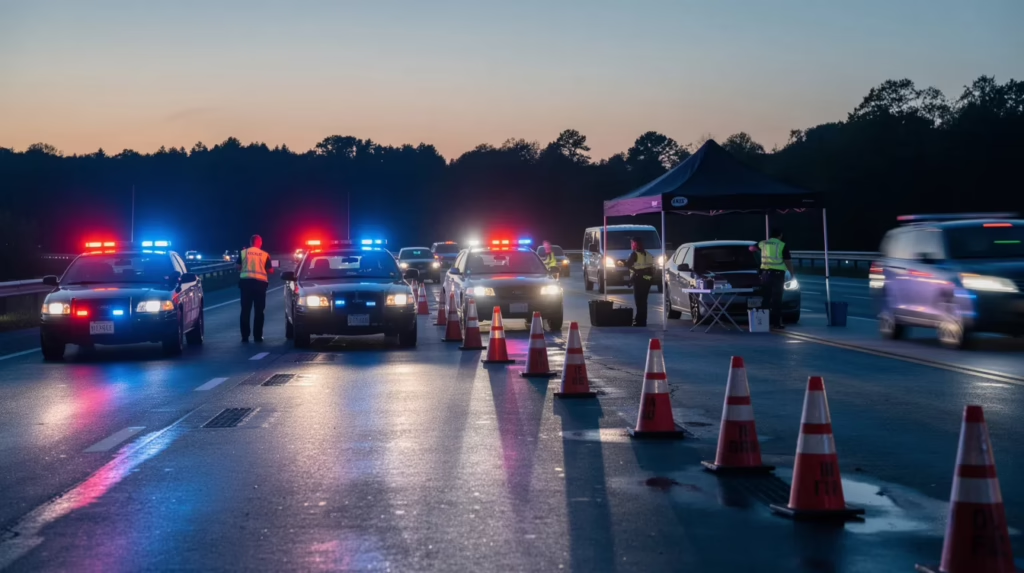
A criminal DUI conviction establishes that the driver broke the law at the time of the crash. In a civil injury case, that conviction serves as strong evidence that the driver breached the duty of care owed to everyone else on Utah roads.
To recover compensation after an accident, a victim generally must prove the other driver was negligent: that they owed a duty of care, breached that duty, and caused harm. A DUI conviction under Utah Code 41-6a-502 demonstrates that the driver was operating a vehicle while impaired or with an unsafe blood alcohol concentration, which is a clear breach of the standard of care required of every driver.
BAC test results from the criminal case can be introduced in civil proceedings to show the degree of impairment. Police reports, field sobriety results, and witness testimony gathered during the criminal investigation all become potential evidence in your personal injury claim. Even if the driver pleads to a lesser charge such as impaired driving, the underlying chemical test data and officer observations remain available.
A person can be convicted of DUI if impaired by drugs or alcohol to the extent that they cannot safely operate a vehicle. This standard, focused on actual impairment rather than a bright-line BAC number, means civil cases can draw on a range of evidence beyond the breathalyzer alone.
Insurance companies evaluate claims based on evidence of fault. A DUI conviction removes much of the ambiguity about who caused the crash and why. When the at-fault driver has a documented influence violation on their record, insurers have less room to dispute liability.
That said, insurers may still attempt to minimize the value of your claim by contesting the severity of your injuries, questioning medical treatment, or arguing that the crash would have occurred regardless of impairment. A conviction helps, but it does not resolve every dispute in the claims process.
Utah law allows for punitive damages in cases involving particularly reckless or willful conduct. Under Utah Code 78B-8-201, effective July 1, 2026, certain limitations on punitive damages do not apply in cases arising from operating a motor vehicle while voluntarily intoxicated or under the influence as prohibited by Utah Code 41-6a-502. This means drunk driving cases may qualify for punitive damages more readily than other personal injury claims, provided there is clear and convincing evidence that the driver acted with willful, malicious, or recklessly indifferent conduct.
Punitive damages go beyond compensating for medical bills and lost wages. They are designed to punish especially dangerous behavior and deter similar conduct, which makes them particularly relevant when a DUI involves serious bodily injury or death, with automobile homicide being the most severe example in a fatal crash.
After a drunk driving accident, two separate legal processes may unfold at the same time. The criminal case is brought by the state against the driver. The civil case is brought by the victim (or the victim’s family) seeking compensation for injuries and losses. These are independent proceedings with different rules, different burdens of proof, and different objectives.
The criminal and civil cases operate on their own schedules:
You can be charged for DUI without actively driving. Utah law defines actual physical control broadly, meaning a person can be arrested while asleep in a vehicle if they are in possession of keys and in a position to operate the motor vehicle. Actual physical control applies to various vehicle types, not just cars. This matters in civil cases because it means a DUI arrest and conviction can occur even in situations where the driver was not behind the steering wheel at the moment of contact.
Understanding the difference between these two proceedings helps victims make informed decisions:
An IID, or ignition interlock device, prevents a vehicle from starting without a breath test as part of Utah’s ignition interlock system. IID installation costs around $150 in Utah, and IID maintenance fees can reach $150 monthly. Ignition interlock restrictions last 18 months for adults and 36 months for drivers under 21. While these administrative penalties affect the convicted driver’s driving privileges, including a person’s driver license, and daily life, they do not directly compensate the victim. That is the role of the civil claim.
A civil case can succeed even if the criminal case results in acquittal, a plea to a lesser charge, or dismissal. The lower burden of proof in civil court means evidence that falls short of “beyond a reasonable doubt” may still be sufficient to prove liability by a “preponderance of the evidence.”
The drunk driver is not always the only party responsible for a victim’s injuries. Under Utah’s Alcoholic Product Liability Act, codified in Title 32B, Chapter 15, additional parties who served or provided alcohol may share liability.
Utah Code 32B-15-201 creates strict liability for commercial sellers and servers of alcohol, including bars, restaurants, breweries, and clubs. A commercial establishment can be held liable when it gives, sells, or otherwise provides an alcoholic product to:
If that person’s intoxication then causes injury to a third party, the injured victim or their heirs may bring a claim against the establishment. Proof of negligence is not required for these claims. The statute imposes strict liability.
However, dram shop claims are subject to damage caps under Utah Code 32B-15-301: recovery is limited to one million dollars per injured person and two million dollars for all injured parties in the same incident. Punitive damages are excluded under the dram shop statute. The statute of limitations for dram shop claims is two years from the date of injury, which is shorter than the four-year deadline for general personal injury claims.
Alcohol retailers in Utah must conduct 100 percent ID checks for alcohol purchases, which is relevant when evaluating whether an establishment met its obligations.
Social host liability under Utah Code 32B-15-201 applies in more limited circumstances. A person age 21 or older can be held liable when they directly give or otherwise provide alcohol to someone they know or should know is under 21, and that underage person becomes intoxicated and causes injury to a third party.
This is an important limitation: social host liability in Utah generally does not extend to hosts who serve legal-age adults. If a host serves alcohol to guests who are 21 or older, the host is typically not liable under this statute, even if a guest becomes intoxicated and causes a crash.
Social host claims follow the same damage caps and two-year statute of limitations as dram shop claims.
Building a dram shop or over-service case requires evidence that the establishment served alcohol to someone who was visibly intoxicated or underage. Useful evidence includes:
These claims can significantly increase total compensation by adding an additional liable party with commercial insurance coverage, which is especially valuable when the drunk driver has minimal or no insurance.
Even with strong evidence of a driver’s impairment, victims face practical and legal obstacles in recovering fair compensation.
Insurers frequently delay settlement offers while waiting for the criminal DUI case to resolve. This can leave victims waiting months or even years for compensation while dealing with mounting medical bills and lost income. The criminal timeline is outside the victim’s control, but the civil claim is not.
A victim can and should pursue the civil case independently. Filing a claim, gathering evidence, and beginning discovery do not require the criminal case to be finished. Working with a Utah car accident attorney can help keep the civil claim moving forward while the criminal process unfolds. A free consultation can help a victim review their legal options.
Drunk drivers are statistically more likely to carry minimal insurance or no insurance at all. When the at-fault driver’s liability coverage is insufficient to cover serious injury or wrongful death damages, victims should explore additional options:
Utah’s implied consent law requires drivers to submit to chemical testing when suspected of DUI. Refusing a chemical test after a DUI arrest leads to administrative penalties, including license suspension through the Utah driver license division. While this refusal and the resulting driver license suspension are criminal and administrative consequences, the refusal itself can be used as evidence in a civil case to suggest consciousness of guilt.
Critical evidence can disappear quickly after a crash. Vehicle data, surveillance footage, witness memories, and physical evidence at the scene all degrade over time. Victims should take immediate steps:
Acting quickly is especially important for potential dram shop claims, where the two-year statute of limitations creates a shorter window. Gathering evidence of over-service early, before records are lost or footage is overwritten, protects your legal options.
Utah follows a modified comparative negligence system under Utah Code sections 78B-5-817 through 823. A victim can recover damages even if partially at fault, as long as the victim’s share of fault does not exceed 50 percent. Damages are reduced proportionally by the victim’s percentage of fault. Defense attorneys and insurers may try to shift blame onto the victim, so understanding how fault is determined and documenting the impaired driver’s conduct thoroughly is essential.
Utah’s strict DUI laws, from the nation’s lowest BAC limit to broad definitions of actual physical control and escalating penalties for prior offenses, create a strong legal foundation for accident victims pursuing compensation. A DUI conviction provides powerful evidence of negligence, and Utah’s dram shop and social host statutes may open additional paths to recovery beyond the driver alone.
If you or a family member has been injured by a drunk driver on Utah roads, consider these steps:
Related topics that may affect your situation include Utah car accident laws, uninsured motorist coverage, and wrongful death claims. Each involves its own rules and deadlines under Utah law.
Esta es información general, no constituye asesoramiento jurídico.
No. The civil claim and the criminal case are separate proceedings with independent timelines. You can file a civil lawsuit or begin an insurance claim while the criminal case is still pending. In fact, waiting too long risks missing the statute of limitations, which is four years for most personal injury claims and two years for wrongful death or dram shop claims.
Yes. Even if the criminal charge is reduced to impaired driving under Utah Code 41-6a-502.5, the underlying evidence of impairment, including BAC test results, police observations, and witness testimony, remains available for use in your civil case. Civil liability does not depend on a specific criminal conviction.
You may still have options. Your own auto insurance policy may include uninsured or underinsured motorist coverage. You may also have a dram shop claim against a bar or restaurant that illegally served the driver, or a social host claim if alcohol was provided to an underage person. Each of these represents a potential source of compensation beyond the driver’s own coverage.
Under Utah Code 78B-2-307, the statute of limitations for most personal injury claims is four years from the date of injury. Wrongful death claims must be filed within two years of the date of death under Utah Code 78B-2-304. Dram shop and social host claims carry a two-year deadline from the date of injury.
Utah law allows punitive damages in cases involving willful, malicious, or recklessly indifferent conduct. Under Utah Code 78B-8-201, certain limitations on punitive damages do not apply in cases involving a driver who was voluntarily intoxicated in violation of Utah Code 41-6a-502. Whether punitive damages apply depends on the specific facts of each case.
Utah law defines actual physical control broadly. A person can face a DUI charge even without actively driving. Actual physical control includes being in possession of keys while positioned to operate a vehicle. A person can be arrested while asleep in a vehicle under this standard. This broad definition means DUI charges and convictions can arise in a wide range of circumstances, all of which may support a victim’s civil claim.
Drivers under 21 face a zero-tolerance standard. Any detectable alcohol in the person’s body can result in penalties, regardless of whether the BAC reaches 0.05 percent. If an underage driver causes a crash with any measurable alcohol, both criminal and civil consequences may follow, and additional dram shop or social host claims may apply if someone illegally provided the alcohol.