

Pedestrians have a conditional right of way in Utah, not an absolute one. Whether a pedestrian or a driver must yield depends on where the pedestrian is crossing and the circumstances of the crossing. Pedestrian right-of-way in Utah is governed by the Utah Traffic Code, specifically Utah Code 41-6a-1002 and Utah Code 41-6a-1003, which together establish a framework of shared responsibility between drivers and pedestrians.
Here is how it works: drivers must yield to pedestrians in crosswalks, whether those crosswalks are marked or unmarked. But pedestrians crossing outside of crosswalks must yield to vehicles. A pedestrian cannot suddenly leave a curb or other safe place and walk or run into the path of a vehicle so close as to create an immediate hazard. And a driver who sees a pedestrian in a crosswalk must slow down or stop, regardless of whether that crosswalk has painted lines.
Utah pedestrian laws treat right of way as situational, and Utah has its own set of rules for how drivers and pedestrians share that duty. The location of the pedestrian crossing, the presence or absence of traffic control signals, and the behavior of both drivers and pedestrians all factor into who has the legal obligation to yield.
This page covers:
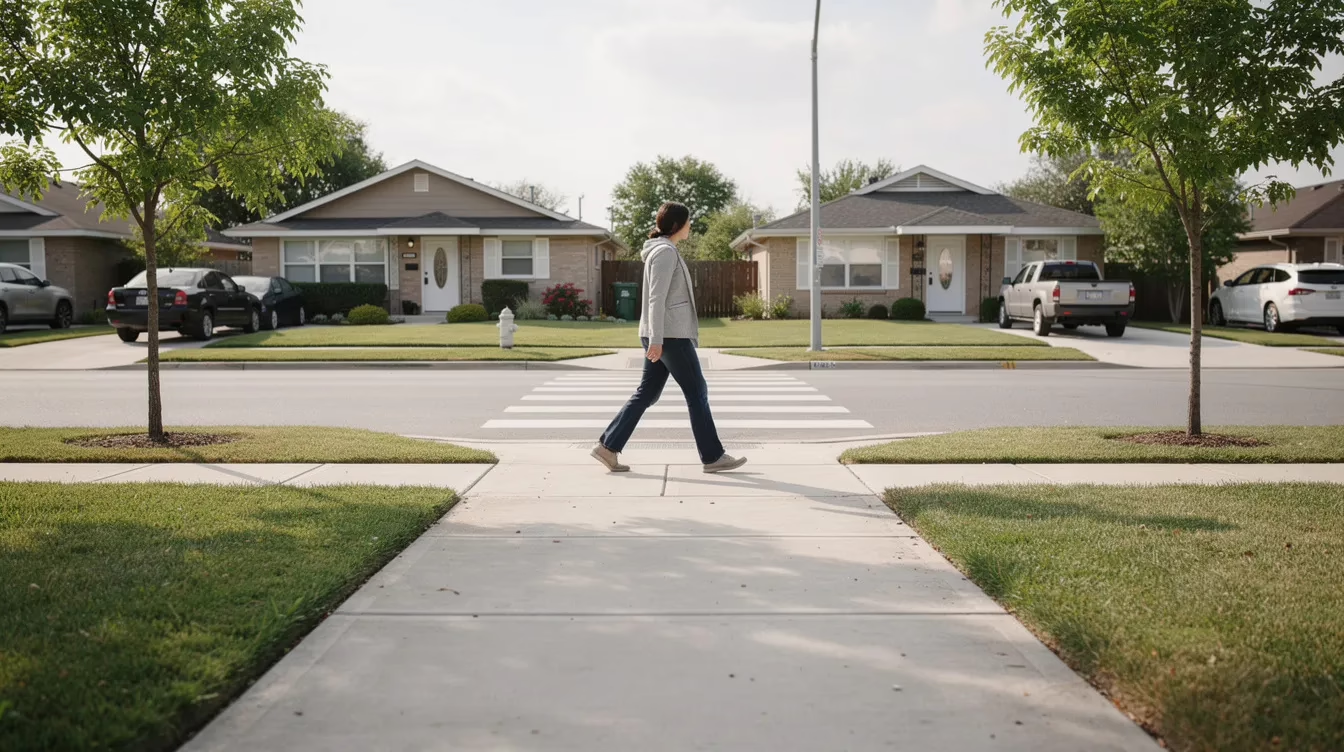

Understanding utah crosswalk laws starts with knowing what legally qualifies as a crosswalk. Utah defines a crosswalk as marked or unmarked areas at roadway intersections. Under Utah Code 41-6a-102, a crosswalk is the portion of a roadway at an intersection included within the connections of the lateral lines of sidewalks on opposite sides of the highway. If there are no curbs, the crosswalk is measured from the edges of the traversable roadway.
A marked crosswalk has painted lines, zebra stripes, or other visible surface markings that show pedestrians where to cross. These are common at busy intersections, near schools, and in commercial areas.
An unmarked crosswalk exists at virtually every intersection where sidewalks or paved edges are present on both sides, even if there is no paint on the road surface. If one side of the roadway has no sidewalk, the crosswalk is measured across the extension of the existing sidewalk at right angles to the roadway centerline.
A school crosswalk is a specially designated pedestrian crossing near schools. School crosswalks may have enhanced markings and carry additional obligations for drivers, which are discussed below.
Mid-block crossings, meaning areas between intersections that are not marked as crosswalks, are not considered crosswalks under Utah law. Pedestrians crossing at these locations are crossing outside a crosswalk and must follow different rules.
The most common misconception about utah crosswalk laws is that a crosswalk must be painted to count. It does not. Under Utah law, both a marked crosswalk and an unmarked crosswalk at a roadway intersection carry the same legal protections for pedestrians. Vehicles, including cars, must stop for pedestrians at both marked and unmarked crosswalks.
The practical difference is visibility. A marked crosswalk with painted lines alerts drivers that pedestrian crossing is expected at that location. An unmarked crosswalk has no visual cues on the road surface, which means vehicle drivers may not immediately recognize that a legal crosswalk exists. Drivers should recognize that any intersection with sidewalks on opposite sides creates an unmarked crosswalk, even without road markings.
Utah Code 41-6a-1002 sets out when drivers must yield to pedestrians. The rule applies at every marked or unmarked crosswalk and creates specific obligations depending on the pedestrian’s position.
Drivers must yield to pedestrians in crosswalks when:
Utah law requires drivers to yield to pedestrians in crosswalks under both of these conditions. The standard is whether the pedestrian is close enough to constitute an immediate hazard, not whether the pedestrian has already reached the driver’s lane.
Drivers have a general duty to exercise care to avoid hitting pedestrians. This duty exists independent of whether the pedestrian is in a crosswalk. Drivers must remain alert to pedestrians in low-light conditions, near intersections, and anywhere pedestrians are likely to be present.
If a vehicle is stopped to allow a pedestrian to cross at a marked or unmarked crosswalk, drivers cannot pass vehicles stopped for pedestrians at crosswalks. Any other vehicle approaching from the rear must not overtake the stopped vehicle. This rule prevents the dangerous situation where a pedestrian steps past a stopped vehicle into the path of a passing car.
In school zones, drivers must stop for pedestrians in crosswalks. Utah Code 41-6a-1002 requires a complete stop at a school crosswalk when a person is in the crosswalk. Drivers must stop for pedestrians in school crosswalks until they clear the road, meaning the driver must remain stopped until the person reaches the opposite sidewalk. School crosswalks require drivers to stop for pedestrians at all times, regardless of the status of traffic control signals.
When making a right turn on red or a left turn at an intersection, turning drivers must still yield to pedestrians in crosswalks. This obligation is embedded in the yield requirements of Utah Code 41-6a-1002. Paying attention to crosswalks during turns is critical because turning movements create blind spots that make it harder to see a pedestrian crossing.
At intersection locations without traffic signals, the same crosswalk yielding rules apply. The absence of a signal does not eliminate the driver’s duty to yield at a crosswalk.
Utah Code 41-6a-1003 establishes when pedestrians must yield the right of way to vehicles. The core rule is straightforward: pedestrians must yield to vehicles when crossing outside of crosswalks.
When a pedestrian is crossing at any point other than within a marked or unmarked crosswalk at an intersection, the pedestrian must yield to all vehicles on the roadway. Crossing without a crosswalk requires yielding to traffic in every direction.
Pedestrians also have obligations even when they do have the right of way in a crosswalk. A pedestrian cannot suddenly enter traffic in front of oncoming vehicles or step out unless an approaching driver can stop safely. Under Utah Code 41-6a-1002, no pedestrian may suddenly leave a curb or other place of safety and walk or run into the path of a vehicle so close as to constitute an immediate hazard. This means pedestrians share responsibility for their own safety even at locations where drivers must yield.
If a pedestrian tunnel or overhead pedestrian crossing is available, pedestrians are expected to use it. Crossing at street level when such a facility exists may shift right of way obligations.
Bicycles must yield to pedestrians on sidewalks or trails, a separate but related obligation that applies in areas where pedestrians and cyclists share space.
Crossing outside a crosswalk is what most people call jaywalking. Under Utah Code 41-6a-1003, pedestrians crossing mid-block must yield to vehicles, and several additional restrictions apply.
Between adjacent intersections that both have traffic signals, pedestrians may not cross the roadway except in a marked crosswalk. This restriction eliminates mid-block crossing entirely in areas where signalized intersections are close together.
Pedestrians must use crosswalks when available. Specifically, pedestrians must use crosswalks within 700 feet. When a pedestrian tunnel or overhead walkway is available within a reasonable distance, crossing at street level triggers the obligation to yield to all traffic.
Diagonal crossing at an intersection is prohibited unless a traffic control device specifically authorizes it. Even where diagonal crossing is permitted, the pedestrian must follow the directions of the traffic control device.
Pedestrians crossing mid-block must yield to vehicles. This means the pedestrian must wait until the roadway is clear before crossing. If a collision occurs while a pedestrian is crossing outside a crosswalk, the pedestrian’s failure to yield can be a significant factor in determining fault.
Jaywalking can result in fines up to $750 in Utah. A violation of Utah Code 41-6a-1003 is classified as an infraction. The Utah Uniform Fine Schedule lists a suggested fine of $130 for pedestrian yielding violations, but courts may impose fines up to $750 depending on the circumstances.
Pedestrians must use crosswalks when available, or face penalties. Citations for jaywalking are most commonly issued in areas with heavy pedestrian traffic, near schools, and in downtown areas such as Salt Lake City where enforcement is more active.
Enforcement varies between municipalities. In some areas, jaywalking citations are issued frequently. In others, officers rarely cite pedestrians for crossing violations unless the behavior contributed to a collision or created a clear safety hazard.

Pedestrians must obey traffic signals at intersections. Utah Code 41-6a-1005 requires pedestrians to follow walk and don’t walk pedestrian signals where they are installed. These signals communicate when it is safe to begin crossing and when pedestrians should not enter the crosswalk.
When a pedestrian signal displays a walk indicator or a walking figure, pedestrians may enter the crosswalk and begin crossing. When the signal changes to a flashing don’t walk or a flashing hand, pedestrians who have not yet entered the crosswalk must not begin crossing. Pedestrians who are already in the crosswalk when the signal changes should complete their crossing. Before stepping out, pedestrians should make eye contact with turning drivers when possible.
Many intersections in Utah use push-button activation systems for pedestrian signals. Pedestrians must press the button to activate the pedestrian phase of the signal cycle. Without pressing the button, the signal may not provide adequate crossing time.
At intersections where no pedestrian signals are installed, pedestrians should obey traffic control signals, meaning they should cross only when the traffic signal for their direction of travel is green.
The rules are clear:
Failing to obey traffic control signals can affect fault determination if a collision occurs.
Utah Code 41-6a-1009 establishes where pedestrians must walk when traveling along a roadway rather than crossing it.
When a sidewalk is provided and its use is practicable, pedestrians must use the sidewalk. Walking along the roadway when a sidewalk is available is a violation of Utah pedestrian laws.
When no sidewalk is available, pedestrians walking along or on a highway must walk on the shoulder, as far as practicable from the edge of the roadway.
When neither a sidewalk nor a shoulder is available, pedestrians must walk as near as practicable to the outside edge of the roadway. On a two-way road, this means walking on the left side of the roadway, facing oncoming traffic. Walking facing traffic allows pedestrians to see vehicles approaching and react to potential hazards.
Utah Code 41-6a-1009 also prohibits conduct that impedes or blocks traffic on high-speed roadways, including freeways, interstate highways, state routes, and roads with speed limits over 35 miles per hour that have medians. Pedestrians are prohibited from exchanging property or money with persons in motor vehicles on these roadways.
Pedestrians who are under the influence of alcohol or drugs may not walk on a highway except on a sidewalk.
Violations of Utah pedestrian and driver yielding laws carry the following consequences:
Enhanced penalties may apply in school zones and at school crosswalks where pedestrian safety obligations are heightened.
If you were injured as a pedestrian in a collision with a motor vehicle, these utah pedestrian laws directly affect how fault is determined and what compensation may be available.
Utah’s comparative negligence law affects compensation after accidents. Under this system, fault can be shared between the pedestrian and the driver. If the driver violated Utah Code 41-6a-1002 by failing to yield to a pedestrian in a crosswalk, that strengthens the injured pedestrian’s claim. If the pedestrian was crossing outside a crosswalk and failed to yield as required by Utah Code 41-6a-1003, the pedestrian’s share of fault may reduce any recovery proportionally.
Civil liability may arise from pedestrian accidents due to negligence by either party. Key factors include whether the pedestrian was in a crosswalk, whether the driver was paying attention, the speed of the vehicle, visibility conditions, and whether either party violated a specific traffic statute.
Pedestrians can seek compensation for medical expenses after an accident, as well as other losses resulting from the collision. Legal representation can help manage insurance communications after an accident and protect the injured person’s interests during the claims process.
If you were hurt in a pedestrian accident, speaking with an attorney experienced in these cases can help you understand how Utah law applies to your situation. Robert J. DeBry & Associates handles pedestrian and car accident cases across Utah and can discuss your circumstances in a free consultation.
Esta es información general, no constituye asesoramiento jurídico.
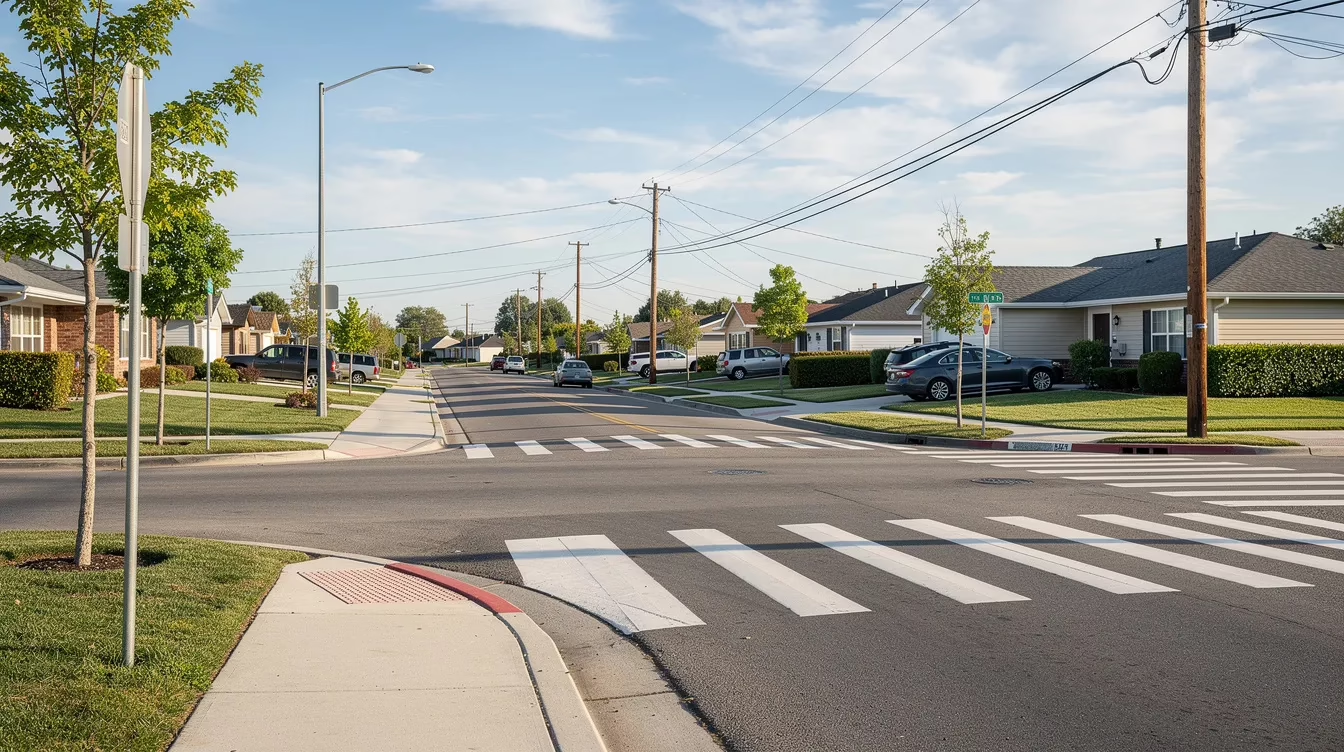
Pedestrians have the right of way in marked or unmarked crosswalks at intersections. Drivers must yield to pedestrians in these crosswalks. However, pedestrians do not have the right of way everywhere. When crossing outside a crosswalk, pedestrians must yield to all vehicles.
Yes. Under Utah Code 41-6a-1003, crossing a roadway outside a marked or unmarked crosswalk without yielding to traffic is an infraction. Between adjacent intersections with traffic signals, pedestrians may only cross in a marked crosswalk. Jaywalking can result in fines up to $750 in Utah.
No. Utah law recognizes both marked and unmarked crosswalks. An unmarked crosswalk exists at any intersection where sidewalks are present on opposite sides of the road, even without painted lines or other markings. Drivers must yield to pedestrians in both types.
Yes. Violating Utah Code 41-6a-1003 is an infraction. The Utah Uniform Fine Schedule lists a suggested fine of $130 for pedestrian yielding violations, and fines can reach up to $750.
No. When a pedestrian is crossing outside a marked or unmarked crosswalk, the pedestrian must yield the right of way to all vehicles. The pedestrian does not have the right of way in this situation.
The pedestrian’s failure to yield as required by Utah Code 41-6a-1003 may be considered in fault allocation. However, drivers still have a general duty to exercise care to avoid hitting pedestrians. Utah’s comparative negligence system means fault can be shared. An injured pedestrian may still have a claim, but recovery could be reduced in proportion to the pedestrian’s share of fault. An attorney can help evaluate how the specific facts affect a potential claim.
Item # on Photos for ALL Shortcode Pages